














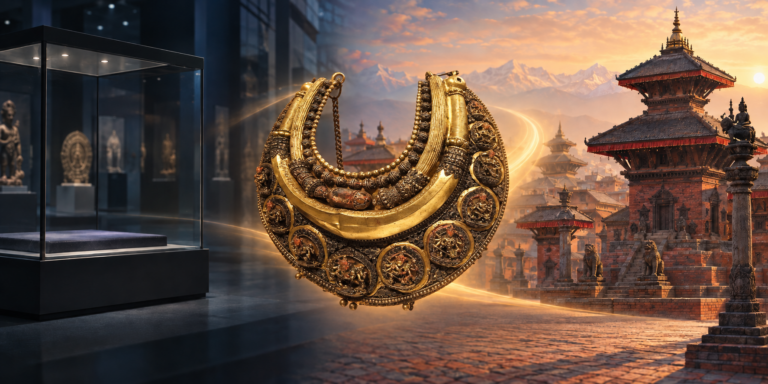

Five years after a visit to the Art Institute of Chicago helped draw international attention to Taleju Bhawani’s sacred necklace, there is finally hope that it may soon return to Nepal.
The necklace has reportedly been removed from display, and Nepal’s Department of Archaeology says the process of returning it has begun. But one important question remains unanswered: When exactly is it coming home?
For Dr. Sweta Gyanu Baniya, who has strongly advocated for the necklace’s return since seeing it inside the Chicago museum in 2021, promises of an eventual return are no longer enough.
“We cannot wait. We need a date,” she wrote in a new post published on September 11.
Related Article: A Reality Check Presented by a Stolen Nepali Artifact Found in a Chicago Museum
The Visit That Drew International Attention
In June 2021, Dr. Baniya visited the Art Institute of Chicago and saw the necklace displayed in its Asian art collection.
For an ordinary museum visitor, it may have appeared to be a beautiful historical object. For many Nepalis, however, it was something sacred that should never have been displayed as museum property.
The necklace is connected to Taleju Bhawani, the patron goddess of the Malla kings. An inscription links it to King Pratap Malla, who ruled Kathmandu from 1641 to 1674.
Gold necklace of king Pratāp Malla (r. 1641-74)
NepālmandalaMalla donated this ornament to his clan goddess (kuldevi) Tulajā Bhawāni. The king used to wear this in #Tantra rituals. It is mentioned as necklace of the “king of kings, lord of kings, lord of.. (1/2)#Newar #Nepal pic.twitter.com/zhyIjCmrJv
— Sarvāmnāya Newah Veda-Tantra (@NewahVeda) February 15, 2021
Dr. Baniya posted a video and photographs from the museum along with a direct appeal: Taleju Bhawani wanted her necklace back.
I took this video yesterday at Art Institute of Chicago where stolen piece of our Taleju Bhawani (our Goddess ) from Nepal is openly displayed @artinstitutechi pic.twitter.com/20vsrsIuNx
— Dr. Sweta Gyanu Baniya (@Sunkesharee) June 12, 2021
Her post helped bring wider attention to the necklace and raised difficult questions about how sacred Nepali objects ended up in foreign museums and private collections.
NepaliSite covered her effort at the time in the article, “A Reality Check Presented by a Stolen Nepali Artifact Found in a Chicago Museum.”
What Has Changed?
The necklace is believed to have disappeared from Nepal in 1976. It was purchased by American collectors James and Marilynn Alsdorf that same year and was later donated to the Art Institute of Chicago.
Nepal formally requested its return in 2021, but the museum asked for additional evidence establishing where the necklace came from and whether it had been illegally removed.
A major piece of evidence was later found in a century-old inventory connected to Taleju. The record described a large gilded necklace bearing the name of Pratap Malla and decorated with pearls and images of the Astamatrika, or Eight Mother Goddesses.
We haven’t heard anything yet. Just want to remind that this holy necklace should be returned and we hope you will listen to us @artinstitutechi
Thank you, Dr. Abhilasha Shrestha @ashrestha for accompanying me and taking my photos and being my moral support. pic.twitter.com/SYJML0E0HE
— Dr. Sweta Gyanu Baniya (@Sunkesharee) December 11, 2021
Nepal’s Department of Archaeology submitted translated records and other supporting documents to American authorities.
According to a recent report by Nepali Times, US Immigration and Customs Enforcement received the additional evidence. The Art Institute of Chicago has since removed the necklace from display and reportedly started working through the legal steps required for its return.
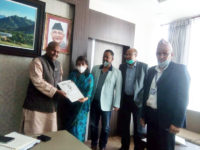
In June, Nepal’s acting ambassador to the United States, Sharad Raj Aran, also met representatives of the Art Institute of Chicago to formally press for the necklace’s return.
Saubhagya Pradhananga, head of Nepal’s Department of Archaeology, told Nepali Times that the necklace is expected to return to Nepal in 2026.
However, the Art Institute of Chicago has not publicly announced a specific return date.
Removed From Display, But Not Yet Home
Removing the necklace from public display is an important development. For years, campaigners questioned why an object claimed by Nepal and considered sacred by worshippers continued to be presented as part of a museum collection.
But removing it from display is not the same as returning it.
In her latest post, Dr. Baniya welcomed the signs of progress but called upon the Art Institute of Chicago, Nepal’s Department of Archaeology, the Nepali Embassy, the Ministry of Foreign Affairs and Kathmandu’s local authorities to announce a firm date.
Her appeal carries particular meaning with Dashain approaching. The Taleju Temple at Hanuman Dhoka is opened to the public only once each year, on Maha Navami.
For worshippers, the necklace is not simply an example of seventeenth-century craftsmanship. It was an offering connected to a living religious tradition.
More Than a Museum Object
The long campaign to bring the necklace back raises a larger question about who carries the burden of proof when sacred objects appear in foreign collections.
Many religious objects in Nepal were worshipped rather than formally catalogued. When those objects disappeared decades ago, communities were not always left with export papers, photographs or police reports.
That lack of documentation can make repatriation extremely difficult, even when inscriptions, religious traditions and historical records connect an object to a particular temple or community.
The Taleju necklace case has also shown how much difference one person can make. Dr. Baniya’s emotional response inside the museum became part of a much larger effort involving priests, heritage activists, journalists, researchers and government officials.
Five years later, that work appears to be producing results.
The necklace may be closer to Nepal than it has been at any point since the campaign began. But until a date is announced—and until the necklace physically arrives—its journey home remains incomplete.
Sources: Dr. Sweta Gyanu Baniya’s latest post, Nepali Times and the Art Institute of Chicago collection record.
Editorial note: This article was prepared with AI assistance and reviewed and fact-checked by NepaliSite using the sources linked above.

0 Comments