













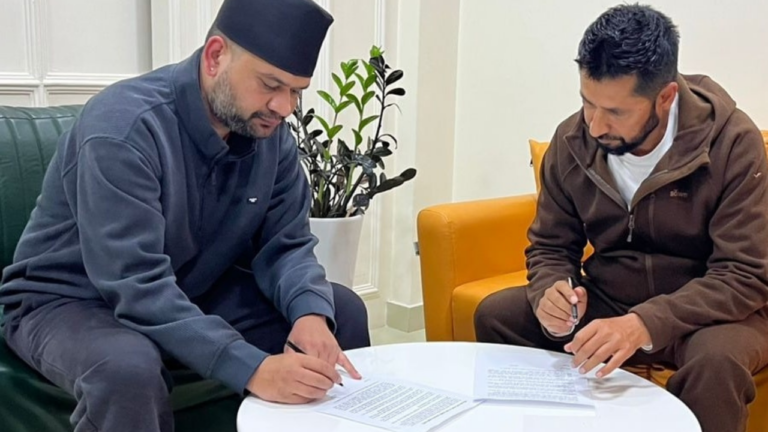

Rastriya Swatantra Party (RSP) Chair Rabi Lamichhane and Kathmandu Metropolitan City Mayor Balendra “Balen” Shah have signed a seven-point political agreement, concluding days of talks and marking a major new alliance ahead of Nepal’s March 5, 2026 House of Representatives election.
The agreement was finalized in the early hours of Sunday after overnight discussions and was signed by both leaders together.
Under the deal:
-
Rabi Lamichhane will remain the central chairperson of the Rastriya Swatantra Party.
-
Balendra “Balen” Shah will become the parliamentary party leader and the party’s prime ministerial candidate after the upcoming election.
-
The party’s name, flag, and election symbol (bell) will remain unchanged.
The seven points of the agreement are
-
Commitment to the youth-led anti-corruption movement and properly addressing the demands of those injured and the families of martyrs.
-
Honest implementation of a roadmap to transform Nepal into a respectable middle-income country within the next decade through deep policy, institutional, and structural reforms focused on economic and social progress and good governance.
-
After unification, the party will be officially called the Rastriya Swatantra Party; its flag will feature a blue bell inside a white circle on a blue background; the election symbol will be the bell; and the central office will be in the Kathmandu Valley.
-
Rabi Lamichhane will remain party chair, and after the election Balen Shah will be parliamentary party leader and the party’s candidate for prime minister.
-
Responsibility assignments within the party will include youth activists and experienced experts based on merit, inclusivity, and public reputation to strengthen the party’s organizational structure.
-
All party documents will be updated with the Election Commission according to this agreement.
-
The agreement calls on other reform-oriented political forces, groups, and individuals to join under the party’s leadership, principles, and election symbol to advance democratic governance, development, and social justice.
Leaders on both sides have described the pact as a new political force aimed at responding to public demands for change, good governance, and social justice.
This agreement comes after a period of national political mobilization, including the large Gen Z protests in September 2025 against corruption and mis-governance. Those protests reshaped Nepal’s political environment, elevating youth voices and increasing demand for accountability and reform.
